



GOVERNMENTS/ASSOCIATIONS/FASTENER GROUPS
Interview with EFDA President Andreas Bertaggia and Secretary General Alexander Kolodzik

Add to my favorite
2026-11-23
Europe stands as one of the world’s primary markets for fastener demand and imports. With an annual import volume of approximately 1.83 million tonnes—valued at roughly €6.58 billion—it represents a massive commercial opportunity that fastener suppliers worldwide are eager to tap into. Taiwan, in particular, serves as a vital source of supply for European importers; in 2025, Taiwan exported 371,000 tonnes of fasteners (valued at approximately €1.22 billion) to Europe, securing a market share of nearly 20%. Meanwhile, although China’s exports to Europe—totaling 808,000 tonnes (valued at approximately €1.69 billion)—far exceed those of any other country, Chinese suppliers continue to face significant challenges, most notably the EU’s anti-dumping measures. Furthermore, the introduction of the Digital Product Passport (DPP), alongside new EU regulations such as the Carbon Border Adjustment Mechanism (CBAM) and the Packaging and Packaging Waste Regulation (PPWR), is set to impose additional operational cost pressures on fastener suppliers. As the industry prepares for the 2027 Fastener Fair Global in Stuttgart, Germany—the world’s largest trade exhibition for the sector—the editorial team of Fastener World has invited President Andreas Bertaggia and Secretary General Alexander Kolodzik of the European Fastener Distributor Association (EFDA) to share their perspectives. They discuss the impact of these new regulations on the fastener industry, key areas requiring special attention, the outlook for fastener demand within the EU, and insights on collaborating with Asian suppliers, including those from Taiwan.
Interview with EFDA President Andreas Bertaggia
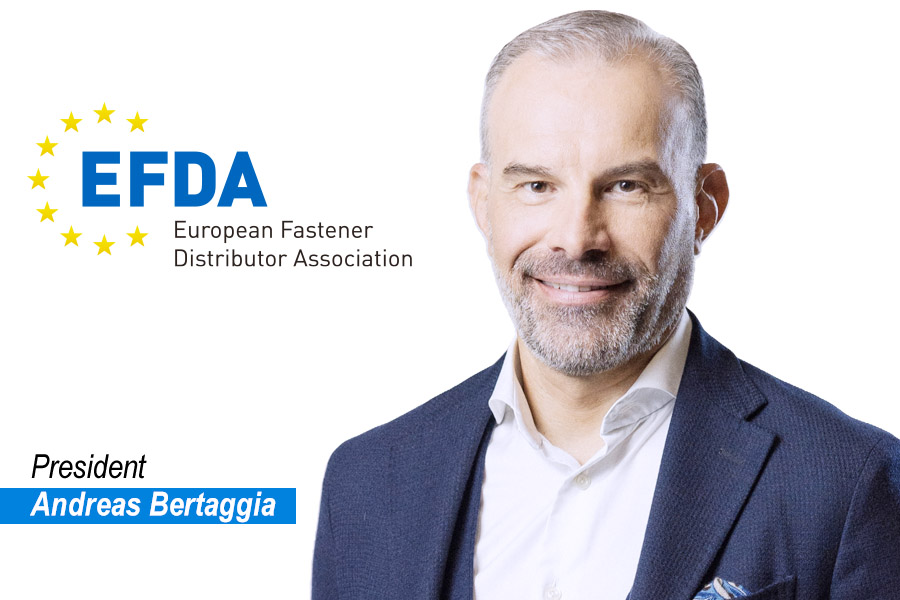
1. According to the EU’s latest 2025 fastener import data, Taiwan is the EU’s second-largest import partner, with imports totaling 370,000 metric tons (1.225 billion euros) of fasteners. This indicates that the proportion of high-value-added products imported from Taiwan is significantly higher than that of peers from other emerging economies. How do you view this trend?
Taiwan remains one of the most important sourcing markets for EU importers and is expected to retain this position in the coming years. At the same time, sourcing patterns are evolving in response to a range of factors, and these developments deserve careful consideration. For Taiwanese manufacturers and exporters, it is therefore important to maintain a clear understanding of their key export markets, including the specific needs of buyers and the conditions in which they operate. By remaining responsive to these market-specific requirements, Taiwanese suppliers can help sustain their strong position.
2. In light of trends in automotive design, are there any notable changes in the demand for automotive fasteners in Europe in 2026? And what signals do these figures reveal?
In 2026, the key development is a change in the type and technical requirements of automotive fasteners, rather than a uniform increase in demand across Europe. Electrification, lightweight construction and the growing complexity of vehicle systems are creating opportunities for more specialized and application-specific fastening solutions, particularly for battery assemblies, thermal management systems and components made from different materials. These applications place greater emphasis on joint reliability, corrosion resistance, precision and consistent quality.
The market figures should nevertheless be interpreted carefully. The signal for suppliers is therefore to focus not only on volume, but also on the changing value of their contribution. Technical expertise, application support, traceability and dependable delivery will be important differentiators. For Taiwanese manufacturers, this presents an opportunity to strengthen their position as long-term partners by working closely with European customers on the requirements of new vehicle platforms.
3. With the advent of the next Fastener Fair Global in Stuttgart and a large group of Taiwanese exhibitors to participle in the fair again, in what areas does EFDA expect to deepen its exchanges and cooperation with Taiwanese fastener industry?
EFDA and its members will once again be attending Fastener Fair Global next year. Naturally, dialogue with suppliers from Taiwan will continue to play a major role at the event. In addition to current market trends, CBAM and the increasing regulation of supply chains as a whole will certainly be a topic that European customers will discuss with their suppliers from Taiwan.
4. Is there anything else you’d like to share with our readers?
Taiwan remains one of Europe’s most valued sourcing partners, recognised for its high standards of service, quality and technical expertise. Equally important are the strong, long-standing relationships between European importers and Taiwanese manufacturers—relationships that provide a solid foundation for our shared future. By building on these strengths through close collaboration and open, transparent communication, we can deepen our partnerships and create new opportunities.
Interview with EFDA Secretary General Alexander Kolodzik
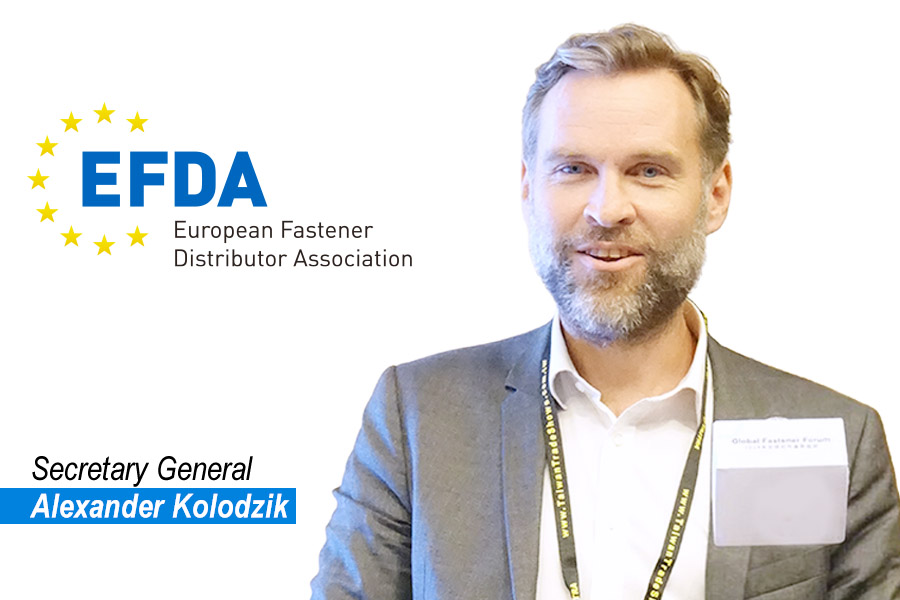
1. In our last interview, you mentioned that the EFDA Assembly of Delegates would be held in Amsterdam in the fall of 2026. Could you share some of the key topics discussed at this event?
The EFDA Assembly of Delegates took place in Amsterdam on November 5 and 6, 2026, at the invitation of EFDA’s Dutch member association, NEVIB. In addition to CBAM and the PPWR, key topics included the possible extension of anti-dumping duties on imports of iron and steel fasteners from the People’s Republic of China.
The antidumping duties are scheduled to expire on 18 February 2027. However, if European manufacturers file a request for a review of the expiry, the Commission will initiate a so-called expiry investigation, during which the duties would continue to be levied even after the expiration date until the Commission reaches a final decision.
2. The Digital Product Passport (DPP) is another EU import barrier following the CBAM, and steel and aluminum products are included in the first wave of affected products. Could you please share the main requirements and impacts of the DPP on the fastener industry?
The DPP is set to become an important new compliance requirement for companies placing products on the EU market. Its significance for businesses lies not only in the information that manufacturers and importers must provide, but also in the potential implications for supplier relationships, product traceability, data management and import procedures. The key point for European fastener distributors is that the fact that steel falls under the DPP does not automatically mean that every finished steel fastener immediately requires its own passport. The scope, product categories, data requirements and implementation deadlines depend on the relevant EU legislation and product-specific regulations. However, these have yet to be finalised for iron and steel products.
3. Is DPP a mandatory requirement for fastener manufacturers? Will all screw products be affected? How does it differ from CBAM in essence?
The impact on fastener distributors and manufacturers will depend on whether the fastener is covered as a finished product in its own right, whether it is supplied as a component of another regulated product, or whether the relevant requirements apply to the steel used to manufacture it. For manufacturers of fasteners, the DPP could become a key prerequisite for continuing to supply the European market. The most significant economic implication is that manufacturers may be required to provide their EU customers with standardised, digitally accessible product and material data – rather than just conventional technical specifications and certificates. However, the specific requirements for iron and steel have yet to be laid down in sector-specific legislation which has not yet been finalised.
The DPP does not, by itself, impose a carbon price or require the purchase of certificates as it does for CBAM. However, it may add costs for IT systems, data collection, verification and product identification. Failure to comply with applicable mandatory requirements can also affect the ability to place covered products on the EU market.
4. Is there a specific timeline currently set by the DPP that fastener manufacturers should pay special attention to? Are there any areas where manufacturers can prepare in advance?
DPP requirements will not be introduced for all products at the same time, but rather gradually for individual product groups. High priority will be given to the iron and steel material group. As soon as the legislation for iron and steel products is adopted, a statutory transition period of at least 18 months will begin.
5. During this year’s Fastener Taiwan in Kaohsiung, the EFDA mentioned that it would produce a handout on the verification of actual emissions data to help suppliers prepare more effectively. Could you please provide an update on the progress of this initiative? Also, what content or outline will the handout generally cover?
In June, EFDA published guidance for suppliers on the scope and importance of verifying actual emissions data, entitled “Why verifying CBAM emissions data is crucial for suppliers – Key parameters for non-EU suppliers for the verification of actual emissions data under CBAM”. This document makes it clear to suppliers that the verification of actual emissions data by an accredited verifier is an absolute prerequisite to ensure that EU importers do not have to purchase CBAM certificates based on standard values, many of which are extremely high. Verification is therefore quite clearly a matter of market competition for fastener manufacturers. The guidance also explains how complex the verification process is, noting that it requires manufacturers to set up a monitoring system and draw up a monitoring plan. Furthermore, it is important that all manufacturers of products relevant to fastener production must have their data verified, including steel mills. Ultimately, it is the responsibility of fastener manufacturers outside the EU to ensure that their suppliers are aware of the significance of CBAM and have their data verified. EFDA also plans to draw up a guide on how to prepare a monitoring plan for the fastener industry. Unfortunately, we are still awaiting detailed confirmation from the Commission as to which production processes are relevant to CBAM and which are not.
專訪
歐洲扣件經銷商協會
理事長Andreas Bertaggia
秘書長Alexander Kolodzik
碳邊境調節機制
數位產品護照
包裝與包裝廢棄物條例
台灣扣件
產業合作
亞洲供應鏈
interview
EFDA
president
secretary general
CBAM
DPP
PPWR
Taiwanese fasteners
industrial collaboration
Asian supply chains
扣件
螺絲
個人防護裝備
手工具
工業用消耗品
經銷商
總經理
扣件
國際展會
惠達雜誌
匯達實業
外銷媒合
廣告刊登
螺絲五金
五金工具
緊固件
台灣扣件展
印度新德里螺絲展
越南河內螺絲展
墨西哥瓜達拉哈拉螺絲展
美國拉斯維加斯螺絲暨機械設備展
2027美國鳳凰城螺絲暨機械設備展
波蘭克拉科夫螺絲展
義大利米蘭螺絲展
德國司徒加特螺絲展
德國杜塞道夫線材展
Fastener
Hand Tool
Hardware
Component
Fastener World
Wire Dusseldorf
Fastener Fair India
Fastener Fair Vietnam
Fastener Fair Mexico
Fastener Poland
Fastener Fair Italy
IFE
Fastener Fair Global


READ NEXT
GOVERNMENTS/ASSOCIATIONS/FASTENER GROUPS
2026-11-23

Subscribe
